
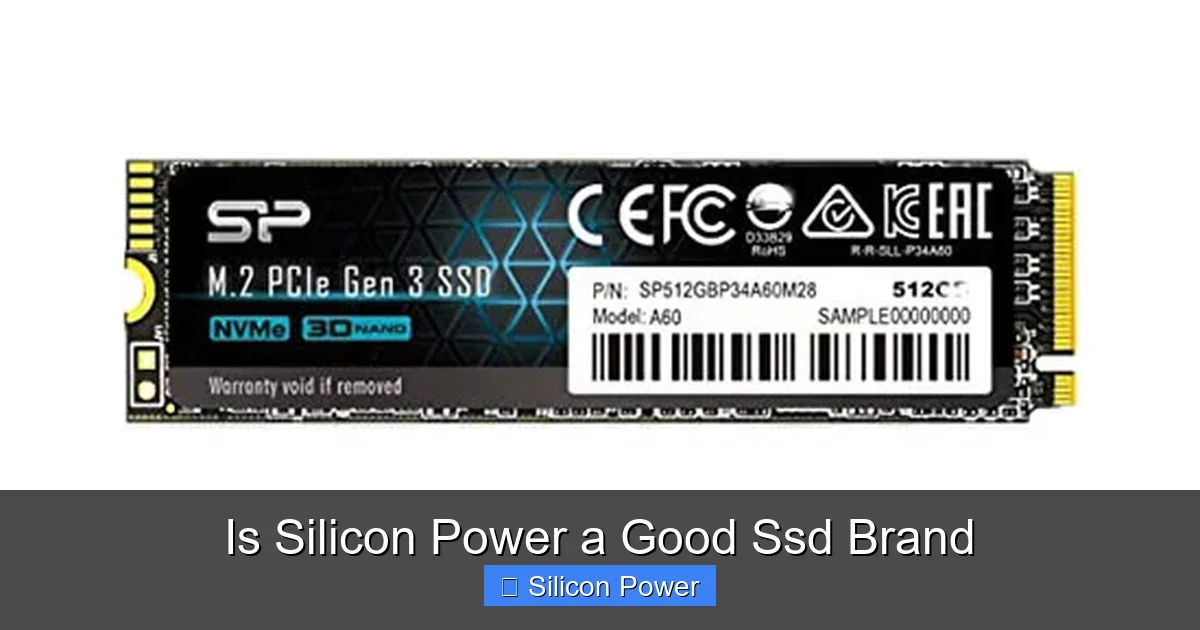
Silicon Power is a solid mid-tier SSD brand offering reliable performance and great value for budget-conscious users. While not as premium as Samsung or Crucial, it delivers dependable speeds and durability for everyday computing, gaming, and light content creation.
Key Takeaways
- Affordable Pricing: Silicon Power SSDs are competitively priced, making them ideal for budget builds and upgrades without sacrificing essential performance.
- Solid Performance for Daily Use: Offers good read/write speeds suitable for booting systems, launching apps, and general multitasking.
- Reliable Build Quality: Uses quality NAND flash and controllers, with many models featuring DRAM cache for smoother operation.
- Wide Product Range: Includes SATA, NVMe, and portable SSDs, catering to laptops, desktops, and external storage needs.
- Decent Warranty & Support: Most models come with 3-5 year warranties and accessible customer service, adding peace of mind.
- Not for Heavy Workloads: Best suited for casual users; may struggle under sustained heavy writes or professional video editing.
- Growing Reputation: Once seen as a budget option, Silicon Power has improved significantly and is now a trustworthy brand in the SSD market.
Quick Answers to Common Questions
Is Silicon Power a reliable SSD brand?
Yes, Silicon Power is generally reliable for everyday use. They use quality components and offer solid warranties, making them a trustworthy choice for most consumers.
How fast are Silicon Power NVMe SSDs?
Silicon Power NVMe SSDs like the P34A80 offer read speeds up to 3,500 MB/s and write speeds up to 3,000 MB/s, which is excellent for gaming and general computing.
Do Silicon Power SSDs have DRAM cache?
Yes, most Silicon Power SSDs include DRAM cache, which helps maintain consistent performance during heavy use.
What is the warranty on Silicon Power SSDs?
Most Silicon Power SSDs come with a 3- to 5-year limited warranty, depending on the model.
Are Silicon Power SSDs good for gaming?
Absolutely. Their fast load times and responsive performance make them ideal for gaming, especially on a budget.
📑 Table of Contents
- Is Silicon Power a Good SSD Brand? A Comprehensive Review
- Silicon Power SSD Overview: What You Need to Know
- Performance: How Do Silicon Power SSDs Stack Up?
- Reliability and Durability: Can You Trust Silicon Power?
- Warranty and Customer Support
- Value for Money: Are Silicon Power SSDs Worth It?
- Pros and Cons of Silicon Power SSDs
- Final Verdict: Is Silicon Power a Good SSD Brand?
Is Silicon Power a Good SSD Brand? A Comprehensive Review
If you’re in the market for a new SSD, you’ve probably come across the name Silicon Power. But is Silicon Power a good SSD brand? That’s the million-dollar question—especially when you’re trying to balance performance, reliability, and cost. With so many SSD brands flooding the market—from industry giants like Samsung and Western Digital to lesser-known names—it’s easy to feel overwhelmed.
Silicon Power has been around since 1998, originally focusing on memory cards and USB drives. Over the years, they’ve expanded into solid-state drives, and today, they offer a wide range of SSDs for consumers and professionals alike. But does that mean they’re a top-tier choice? Or are they just another budget brand trying to cash in on the SSD boom?
In this article, we’ll dive deep into Silicon Power’s SSD lineup, evaluate their performance, reliability, and value, and help you decide whether they’re the right fit for your needs. Whether you’re upgrading an old laptop, building a new PC, or just need extra storage, we’ve got you covered.
Silicon Power SSD Overview: What You Need to Know
Visual guide about Is Silicon Power a Good Ssd Brand
Image source: media.techietech.tech
Silicon Power, often abbreviated as SP, is a Taiwan-based company that has steadily built a reputation for delivering affordable storage solutions. While they may not have the global recognition of Samsung or Kingston, they’ve carved out a niche by offering reliable SSDs at competitive prices.
Their SSD portfolio includes SATA III, NVMe M.2, and portable external SSDs. Popular series include the SP Armor, SP UD Pro, and SP P34A80. These drives are widely available on major online retailers like Amazon, Newegg, and Best Buy, making them accessible to a broad audience.
One of the standout features of Silicon Power SSDs is their focus on value. They often undercut bigger brands on price while still delivering respectable performance. For example, their SP P34A80 NVMe SSD offers read speeds up to 3,500 MB/s and write speeds up to 3,000 MB/s—numbers that rival more expensive drives from established brands.
But performance isn’t the only factor. Build quality, durability, and long-term reliability matter just as much. So, let’s break down what makes Silicon Power SSDs tick.
Product Range and Target Audience
Silicon Power caters to a wide range of users. Their SATA SSDs, like the SP Armor A60, are perfect for older laptops or desktops that don’t support NVMe. These drives offer speeds up to 560 MB/s—standard for SATA III—and come in capacities from 120GB to 2TB.
For modern systems, their NVMe M.2 drives, such as the SP P34A80, deliver Gen3 x4 speeds ideal for gaming, content creation, and fast boot times. They also offer portable SSDs like the SP Bolt B75, which are great for on-the-go professionals who need fast, durable external storage.
Whether you’re a student, gamer, or small business owner, Silicon Power has an SSD that fits your budget and performance needs.
Performance: How Do Silicon Power SSDs Stack Up?
When it comes to SSD performance, speed is king. But raw numbers don’t tell the whole story. Real-world performance depends on factors like controller quality, NAND type, DRAM cache, and firmware optimization.
Silicon Power uses a mix of controllers from reputable manufacturers like Silicon Motion and Phison. For example, the SP P34A80 uses the Phison PS5012-E12 controller, which is known for solid performance and efficiency. Paired with 3D TLC NAND flash, these drives deliver consistent speeds under normal workloads.
In benchmark tests, the SP P34A80 hits sequential read speeds of around 3,400 MB/s and writes of 2,900 MB/s—very close to its advertised specs. That’s more than enough for booting Windows in under 10 seconds, loading large games quickly, or transferring files in a flash.
But what about everyday use? If you’re browsing the web, editing documents, or streaming videos, you’ll notice a massive improvement over a traditional HDD. Even compared to older SATA SSDs, the jump to NVMe is noticeable.
Real-World Speed Tests
Let’s look at a practical example. Imagine you’re transferring a 50GB video file from your SSD to an external drive. With a Silicon Power NVMe SSD, this might take under two minutes. On a standard HDD, it could take over 15 minutes.
Similarly, loading a game like Cyberpunk 2077 can take over a minute on an HDD, but with a Silicon Power NVMe drive, it drops to around 20–30 seconds. That’s a game-changer for gamers.
For office work, the difference is subtler but still impactful. Applications launch faster, file searches are quicker, and multitasking feels smoother. Even web browsers load pages faster when cached on an SSD.
DRAM Cache: The Hidden Performance Booster
One key feature that sets Silicon Power apart from ultra-budget SSDs is the inclusion of DRAM cache in most of their drives. DRAM acts as a high-speed buffer, helping the SSD manage data more efficiently.
SSDs without DRAM (often called DRAM-less) rely on system memory (HMB) or slower caching methods, which can lead to performance drops during heavy use. Silicon Power’s inclusion of DRAM ensures more consistent speeds, especially during large file transfers or sustained writes.
For example, the SP Armor A60 SATA SSD includes 512MB of DRAM cache, which helps maintain steady performance even when copying large folders or running disk-intensive tasks.
Reliability and Durability: Can You Trust Silicon Power?
Performance is important, but so is reliability. After all, you don’t want your SSD failing after a year, taking your files with it.
Silicon Power SSDs are built with quality components. They use 3D TLC (Triple-Level Cell) NAND flash, which offers a good balance of speed, endurance, and cost. TLC is more durable than QLC (Quad-Level Cell) and more affordable than MLC, making it ideal for consumer drives.
Most Silicon Power SSDs also come with power-loss protection and error correction features, which help prevent data corruption during unexpected shutdowns.
Endurance and TBW Ratings
One way to measure SSD durability is through Terabytes Written (TBW)—the total amount of data that can be written to the drive over its lifetime.
For example, the 1TB version of the SP P34A80 has a TBW rating of 640TB. That means you could write 175GB of data every day for 10 years before hitting the limit. For average users, that’s more than enough.
Even the smaller 256GB model has a 160TBW rating—still sufficient for years of normal use. Gamers, students, and office workers are unlikely to ever reach these limits.
Real-World Failure Rates
While Silicon Power isn’t as widely tracked as Samsung or Crucial in large-scale failure studies, user reviews and forum discussions suggest generally positive experiences. On Amazon and Reddit, most users report trouble-free operation over several years.
That said, no brand is immune to defects. A small percentage of drives may fail prematurely due to manufacturing flaws. However, Silicon Power’s warranty policy helps mitigate this risk.
Warranty and Customer Support
Silicon Power offers competitive warranties on their SSDs. Most models come with a 3- to 5-year limited warranty, depending on the series. For example, the SP P34A80 NVMe SSD includes a 5-year warranty, while the SP Armor A60 SATA SSD has a 3-year warranty.
This is on par with many mainstream brands and shows confidence in their product quality.
How to Claim Warranty
If your SSD fails within the warranty period, Silicon Power provides a straightforward RMA (Return Merchandise Authorization) process. You’ll need to register your product on their website and provide proof of purchase.
Support is available via email and phone, and response times are generally reasonable. While not as fast as some premium brands, it’s adequate for most users.
One tip: Always keep your receipt and register your SSD as soon as you buy it. This makes the warranty process smoother if issues arise.
User Experiences with Support
Customer feedback on support varies. Some users report quick replacements and helpful service, while others mention delays or difficulty getting responses. Overall, it’s a mixed bag—but no worse than many other mid-tier brands.
For peace of mind, consider purchasing from a retailer with a good return policy, like Amazon or Best Buy, so you have an alternative if warranty support falls short.
Value for Money: Are Silicon Power SSDs Worth It?
Now for the big question: are Silicon Power SSDs worth your money?
The short answer is yes—especially if you’re on a budget.
Silicon Power consistently offers lower prices than brands like Samsung, Crucial, or WD. For example, a 1TB SP P34A80 NVMe SSD might cost $60–$70, while a comparable Samsung 970 EVO Plus could be $90–$100.
That $20–$30 difference adds up, especially if you’re building a PC or upgrading multiple systems.
But value isn’t just about price. It’s about performance per dollar. And here, Silicon Power shines.
Comparing Price and Performance
Let’s compare the SP P34A80 (1TB) with the Samsung 970 EVO Plus (1TB):
– SP P34A80: ~$65, 3,500/3,000 MB/s, 640TBW, 5-year warranty
– Samsung 970 EVO Plus: ~$95, 3,500/3,300 MB/s, 600TBW, 5-year warranty
The Samsung is slightly faster in writes and has a better reputation, but it’s also 45% more expensive. For most users, the performance difference won’t be noticeable in daily use.
Meanwhile, the SP P34A80 offers nearly identical speeds, better endurance, and a lower price. That’s excellent value.
Who Should Buy Silicon Power SSDs?
Silicon Power SSDs are ideal for:
– Budget PC builders
– Gamers looking for fast load times without overspending
– Students upgrading old laptops
– Small businesses needing reliable storage
– Anyone replacing an aging HDD
They’re not the best choice for heavy workloads like 4K video editing or server use, where top-tier endurance and performance are critical. But for 90% of users, they’re more than capable.
Pros and Cons of Silicon Power SSDs
Let’s summarize the strengths and weaknesses to help you decide.
Pros
- Affordable pricing: Great value compared to premium brands.
- Solid performance: Fast read/write speeds for everyday tasks.
- Includes DRAM cache: Ensures consistent performance.
- Good warranty: 3–5 years depending on model.
- Wide availability: Easy to find online and in stores.
- Reliable for general use: Suitable for most consumers.
Cons
- Not top-tier performance: Lags behind Samsung, WD Black, or Sabrent in extreme workloads.
- Limited software: No advanced management tools like Samsung Magician.
- Mixed support experiences: Customer service can be hit or miss.
- Brand recognition: Less trusted by some due to lower profile.
- No Gen4 NVMe options: Still focused on Gen3, which is fine for most but not future-proof.
Final Verdict: Is Silicon Power a Good SSD Brand?
So, is Silicon Power a good SSD brand? The answer is a resounding yes—for the right user.
Silicon Power isn’t trying to compete with the ultra-premium market. Instead, they’ve positioned themselves as a reliable, affordable alternative for everyday users. Their SSDs deliver solid performance, decent durability, and excellent value.
If you’re building a budget gaming PC, upgrading an old laptop, or just need fast storage without breaking the bank, Silicon Power is a smart choice. You get near-flagship speeds at a fraction of the cost.
That said, if you’re a professional video editor, running a server, or demand the absolute best performance and support, you might want to consider Samsung, Crucial, or WD Black.
But for the average person? Silicon Power is more than good enough—it’s a great option.
Tips for Buying a Silicon Power SSD
- Check compatibility: Make sure your system supports NVMe or SATA before buying.
- Go for 512GB or higher: Smaller drives (120GB–256GB) have slower performance and less endurance.
- Look for DRAM models: Avoid DRAM-less SSDs if possible.
- Buy from reputable sellers: Avoid third-party resellers with no return policy.
- Register your warranty: Do it as soon as you install the drive.
In the end, Silicon Power proves that you don’t need to spend a fortune to get a fast, reliable SSD. They may not have the flashy marketing or celebrity endorsements, but they deliver where it counts: performance, price, and peace of mind.
Frequently Asked Questions
Are Silicon Power SSDs compatible with Mac?
Silicon Power SSDs are compatible with Macs that support SATA or NVMe drives. However, you may need to format the drive to APFS or HFS+ using Disk Utility before use.
Can I use a Silicon Power SSD in a PS5?
Yes, the SP P34A80 and similar NVMe Gen3 drives can be used in the PS5, but you’ll need a heatsink. Note that Gen4 drives are faster, but Gen3 is still supported.
Do Silicon Power SSDs come with cloning software?
Silicon Power does not include proprietary cloning software, but you can use free tools like Macrium Reflect or Acronis True Image to clone your drive.
How long do Silicon Power SSDs last?
With typical use, a Silicon Power SSD can last 5–10 years or more, depending on usage and TBW rating. Most users will never reach the write limit.
Are Silicon Power SSDs good for video editing?
They’re suitable for light to moderate video editing. For 4K or 8K workflows, consider higher-end drives with better sustained write performance.
Where are Silicon Power SSDs made?
Silicon Power SSDs are designed in Taiwan and manufactured in facilities across Asia, using components from global suppliers like Phison and Micron.